
Sciatica / Lumbar Radiculopathy Specialist
Do you have pain that radiates from your buttocks down the back of your leg? If so, you may have a condition called lumbar radiculopathy or sciatica. Lumbar radiculopathy occurs when a nerve root in the lower back becomes irritated or compressed, causing pain, numbness, tingling, or weakness that may travel into the buttock and leg. This pattern of radiating leg pain is commonly called sciatica. Dr. Andre Samuel evaluates the underlying cause and offers nonsurgical and surgical treatment options when appropriate.

What is lumbar radiculopathy?
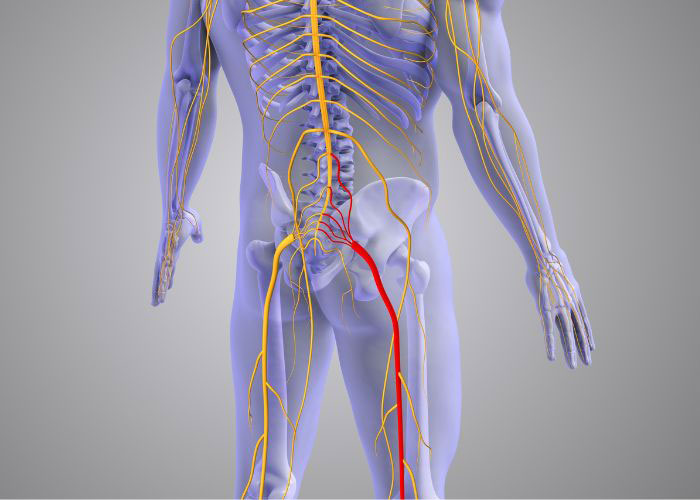
Lumbar radiculopathy is irritation or compression of a nerve root in the lower spine. Depending on which nerve root is affected, symptoms can travel from the lower back or buttock into the thigh, leg, foot, or toes. Sciatica is commonly used to describe pain that travels along the sciatic nerve pathway. Lumbar radiculopathy is one of the most common causes of sciatica symptoms. Dr. Andre M. Samuel, orthopedic spinal specialist serving the Clear Lake, Houston, Sugar Land, Texas area, has the knowledge and understanding, as well as substantial experience, in treating patients who have experienced lumbar radiculopathy.
What causes lumbar radiculopathy?
Common causes of lumbar radiculopathy include a lumbar disc herniation, age-related degenerative changes, spinal stenosis, and bone spurs that narrow the space around a nerve root. When a nerve root becomes compressed, inflamed, or irritated, it can cause pain, numbness, tingling, or weakness that travels from the lower back into the buttock, leg, or foot. The specific symptoms and where they occur depend on which lumbar or sacral nerve root is affected and the degree of irritation or compression.
Are there risk factors for lumbar radiculopathy?
Yes. There are a number of factors that can increase the likelihood of developing sciatica. These include:
- Sciatica is most common in men between 30 and 50 years old.
- Sitting for long periods of time and poor posture can lead to lumbar radiculopathy.
- Individuals who are overweight place additional stress on the lower back.
- Occupational Hazards. Some jobs are more physically demanding with constant lifting, pushing, pulling, and twisting motions. Other occupations, such as truck drivers, require being in a seated position for prolonged periods of time.
- Because of the added stress on the lower back in the final stages of gestation, multiple pregnancies can increase a woman’s likelihood of developing sciatica.
What are the symptoms of lumbar radiculopathy?
Sciatica is most often described as a sharp, knife-like pain that begins in the lower back and radiates into one of the lower extremities. Some other common symptoms of lumbar radiculopathy include:
- Pain localized to the lower back
- Numbness and/or tingling in the foot and toes of the affected lower leg
- Altered sensation in the legs, foot or toes
- Loss of lower extremity muscle strength
How is lumbar radiculopathy diagnosed?
Dr. Samuel will begin asking about the pattern of pain and neurological symptoms, followed by an examination of strength, sensation, reflexes, and nerve tension. An MRI may be used to look for disc herniation, spinal stenosis, or other causes of nerve root compression. Electrodiagnostic testing may be helpful when the diagnosis or affected nerve is unclear.
How is lumbar radiculopathy treated?
Non-surgical treatment:
Lumbar radiculopathy treatment depends on the cause of nerve irritation, symptom severity and duration, neurological findings, and how symptoms affect daily activities. Many patients can be treated without surgery using activity modification, medication, physical therapy, individualized exercises or stretches, and selective spinal injections when appropriate. The majority of individuals with symptoms of sciatica often respond well to treatment with conservative measures.
Surgical treatment:
Surgery may be considered when pain remains disabling despite appropriate nonsurgical care, weakness is progressive, or imaging identifies nerve compression that is appropriate for surgical treatment. There are different techniques to surgically correct lumbar radiculopathy that may also address other conditions such as a herniated disc or bone spurs. Many of these treatments can be done with minimally invasive surgery which offers quicker recovery times and less chance of infection or bleeding. Dr. Samuel will formulate the best surgical approach after reviewing a number of patient-specific factors such as medical history, current symptoms, and the affected nerve root.
Lumbar radiculopathy recovery
Recovery from lumbar radiculopathy varies. Some patients improve with nonsurgical care as inflammation and nerve irritation decrease, while recovery may take longer when symptoms have been severe or present for an extended period. Dr. Andre Samuel provides individualized guidance for physical therapy, activity progression, return to work or exercise, and follow-up after nonsurgical treatment or surgery.
About the Author: Andre M. Samuel, MD


