
Herniated Disc Specialist in Clear Lake, Houston, and Sugar Land
A herniated disc in the neck can also be called a cervical disc herniation, a bulging disc, a ruptured disc or a slipped disc. A herniated disc can irritate or compress a nerve and cause neck pain, arm pain, numbness, tingling, or weakness. This can occur as we age, or even from overuse or from an accident. The discs in the neck or spine can become dehydrated, rigid and can weaken due to normal wear-and-tear. Fellowship-Trained Orthopedic Spine Surgeon, Dr. Andre Samuel, evaluates each patient individually and recommends nonsurgical or surgical treatment based on the location of the herniation, the severity of symptoms, and the patient’s functional goals. He see patients in Clear Lake, Houston, and Sugar Land, Texas offices who are experiencing symptoms associated with a disc herniation in the neck. Schedule an evaluation with Dr. Andre Samuel for a diagnosis and treatment options.
What Is a Herniated Disc in the Neck?
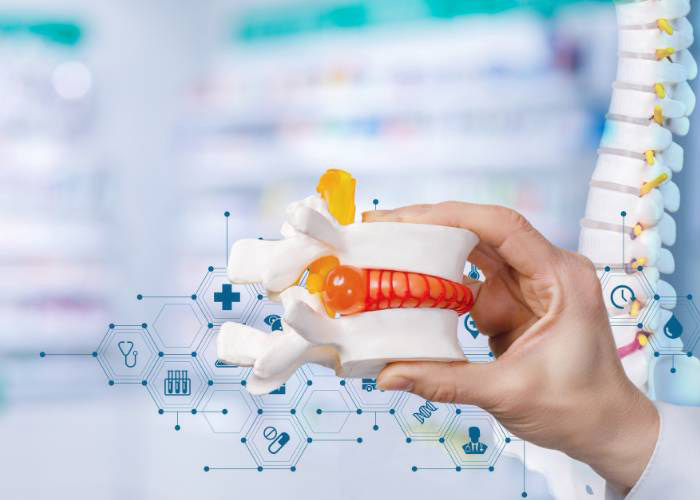
A herniated disc, sometimes referred to as a ruptured or slipped disc, is an advanced injury. When a disc herniates or ruptures, the outer layer of the disc develops a tear, allowing the soft, gel-like inner material to push through the opening. In more severe cases, a portion of the disc can separate completely, creating what is known as a sequestered disc fragment or free fragment. This loose piece of disc material can migrate into the spinal canal and place additional pressure on the spinal nerves.
In the cervical spine, the herniated spinal disc may press on a nearby nerve root and cause symptoms that travel from the neck into the shoulder, arm, hand, or fingers. Cervical disc herniation is most common among individuals in their 30s and 40s, however, older adults are also at risk of developing a cervical disc herniation. For older adults, repetitive wear and tear on their disc from day-to-day regular activity can cause a bulging disc in the neck. Dr. Andre M. Samuel, orthopedic spinal specialist serving the Greater Houston area, has extensive experience and training from the nation’s top hospital for treatment of patients who have experienced cervical radiculopathy.
Several terms are used to describe damage to a spinal disc, but they don’t all mean the same thing. A bulging disc occurs when the disc extends beyond its normal border while the tough outer layer remains intact. Although the disc has not torn, the bulge can still place pressure on nearby spinal nerves and cause pain or other symptoms. This means the disc is bulging, but not yet ruptured or herniated.
What causes a cervical disc herniation?
A cervical disc herniation may develop gradually as a disc loses water content and flexibility, or it may occur suddenly after an injury. The natural aging process can causes dehydration of the spinal discs, creating a more rigid and weaker structure. The gel-like nucleus of the spinal disc may rupture or bulge through a tear in the disc wall. This leads to pressure directly against the nerve root causing irritation and inflammation of the nerves. Factors that may increase risk include repetitive loading, physically demanding work, smoking, genetics, and age-related disc degeneration.
Herniated Disc Symptoms
Herniated disc symptoms vary depending on which nerve is affected and may include sharp, burning, or electric-like pain that travels from the neck into the shoulder, arm, or hand. Progressive arm or hand weakness, worsening balance, loss of coordination, or difficulty using the hands should be evaluated promptly. Herniated disc symptoms may include:
- Pain with neck bending or turning the head
- Muscle spasms
- Loss of upper extremity muscle strength
- Decreased sensation
- Numbness and/or tingling of the upper extremity
- Loss of handgrip strength
How Is a Cervical Herniated Disc Diagnosed?
A thorough medical history and physical examination are performed by Dr. Samuel to diagnose a cervical disc herniation. The neck and upper extremities are evaluated for any signs of muscle weakness, decreased sensation, or abnormalities in the nerve reflexes. An MRI may be recommended when symptoms persist, weakness is present, or the diagnosis is uncertain, but imaging is interpreted together with the physical examination. Because other neck and shoulder conditions can cause similar symptoms, identifying the true source of pain is essential before treatment is recommended.
Herniated Disc Treatment
Non-surgical treatment
Herniated disc treatment is based on the severity and duration of symptoms, the presence of weakness or nerve compression, and how the condition affects daily activities. Many patients improve with activity modification, medication, physical therapy, and selective injections; surgery is generally considered when symptoms persist, neurological deficits progress, or spinal cord compression is present. Dr. Samuel recommends non-steroidal anti-inflammatories (NSAIDs) as well as over-the-counter analgesics, such as Tylenol, to help alleviate pain. Occasionally a short course of oral steroids may be warranted. Dr. Samuel may also suggest that you have a targeted steroid injection to be administered directly to the affected nerve root. Some patients find relief from wearing a soft cervical collar for a short period of time. Physical therapy is also strongly encouraged to strengthen the neck muscles and prevent re-injury to the spine.
When Surgery May Be Recommended
Patients who have tried conservative treatment measures with little to no symptom relief are candidates for surgical intervention. There are a number of different surgical procedures available to correct a cervical disc herniation. Dr. Samuel will consider a number of patient factors, such as age, medical history, and severity of symptoms, to determine which of the following techniques is most appropriate.
- Cervical Disc Replacement (CDR): The herniated disc is completely removed from an incision on the front of the neck and replaced with an artificial disc that preserves motion
- Anterior Cervical Discectomy & Fusion (ACDF). The ruptured disc is completely removed from an incision on the front of the neck. The space is then filled with a bone graft that will fuse to the surrounding vertebrae. This is used for treating discs that have become severely arthritic.
- Posterior Cervical Foraminotomy. The cervical disc herniation is removed through a small incision on the back of the neck. The minimally invasive technique allows less injury to the surrounding muscles and preserves the remainder of normal healthy disc
Herniated Disc Recovery
Recovery from a herniated disc varies based on the severity of nerve irritation, how long symptoms have been present, the treatment used, and the patient’s overall health. Dr. Samuel provides individualized guidance for physical therapy, activity progression, return to work, and follow-up after nonsurgical care or surgery.


